|
Joseph Needham and 'Brand China'
|
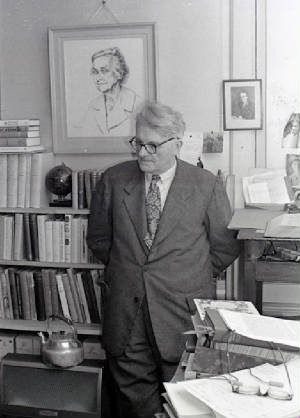
| Joseph Needham in his study, Cambridge University, 1965 |
Mention ‘China’ and
‘science and technology’ in the same breath to someone, and what kind of response are you likely to get? These days, ‘innovative’,
and ‘advanced’ are two of the words that might trip off the tongue. Quite a difference from, say, 20 years ago,
when ‘copycat’, ‘laggard’, and perhaps lots of head-scratching may well have been the typical response.
By any measure, the rapidity of China’s progress in science and technology in the last
two decades has been nothing short of astounding. The rest of the world’s view of China’s development in this
field has been informed by writers, analysts, academics and – most significantly – by people’s own views
of China’s brands and, of course, of the country itself. In 2018, ‘foreign-tourists’
made 30.5 million visits to mainland China; an increase of almost five per cent compared with 2017. Many of those visitors
avidly shared their impressions of China to friends, family, and colleagues via word-of-mouth and the numerous social-media
channels. Consequently, hundreds of millions of people all over
the world are hearing about China’s impressive modernity from people who have experienced the airports, the high-speed
rail network, the subway systems, the 4 and increasingly 5G connectivity, the electric-vehicles and the ‘cashlessness’
themselves. The burgeoning fascination for all things Chinese
has spurred a wave of interest in Chinese history. One of the popular subjects in this genre is ancient China’s technological
superiority. Long-overdue news of China’s ‘four great inventions’ [si da faming] – paper
making, printing, gunpowder, and the compass – has at last reached large numbers of people in the Western world. To
the extent that, these days, any half-decent pub quiz team would be expected to know all the names of the ‘four-greats’.
The story has travelled far and wide. But, as is so often
the case with stories, very few people know the name of the storyteller. This
would not have worried Joseph Needham (1900-1995) in the slightest. He was fully focused on one, albeit Herculean task: To
give China the long-overdue respect it deserves for its scientific contributions to humankind. Joseph Needham studied biochemistry at the University of Cambridge under the tutelage of Sir Frederick Gowland
Hopkins, who would be jointly-awarded the Nobel Prize in Physiology or Medicine in 1929. Needham was a brilliant
student and equally exceptional researcher, who would go on to author more than 100 scientific publications between 1921 and
1942. A Harvard reviewer was so impressed by one of those publications,
a book titled Biochemistry and Morphogenesis, he or she was moved to write: “[It] will go down in the annals
of science as Joseph Needham’s magnum opus, destined to take its place as one of the most truly epoch-making books in
biology since Charles Darwin.” Surely, then, it would only be
a matter of time before he followed Sir Frederick’s path all the way to the Nobel rostrum. Perhaps he would have, had he not met Lu Gwei-Djen (Lu Guizhen), also a biochemist at Cambridge. She had arrived
there in 1937 to pursue post-graduate studies, after fleeing from war-torn Shanghai.
Lu ignited his intense passion for studying Chinese characters, which he went on to describe
as, “…A liberation, like going for a swim on a hot day. [For it gets you] entirely out of the prison of alphabetical
words and into the glittering, crystalline world of ideographic characters.” Lu, whose father was a distinguished
Nanjing pharmacist, also fired Doctor Needham’s fanatical interest in China’s long and illustrious history in
numerous fields of science. Informed by professor Luo Zhongshu, who
was close to scientists in Chengdu (beyond the vast territory occupied by Japanese forces), he realised that China’s
scientific institutions were in a parlous state. Determined to
help, he persuaded the British government that he should be its man in charge of the British Scientific Mission in China.
By 1946, he and his team of 10 Chinese and six British scientists had visited 296 ‘places of learning’ on journeys
totalling many thousands of difficult miles. During this grand tour of schools,
universities, laboratories, and industrial units, the work of this small team resulted in the provision of ‘tons of
scientific equipment’ as well as some 7,000 science books. Many scientists
and others he met were keen to talk about China’s incredible science history. They also introduced him to the literature
that provided the all-important evidence that supported the many wondrous stories.
In the ‘Acknowledgements’ [Preface, page 11] of the first volume of Science
and Civilisation in China [1954], Joseph Needham would write, “The work gave unimagined opportunities for acquiring
an orientation into Chinese literature of scientific and technical interest, for in every university and not a few industrial
installations, there were scientists, doctors and engineers who had themselves been interested in the history of science,
and who were not only able but generously willing to guide my steps in the right paths.”
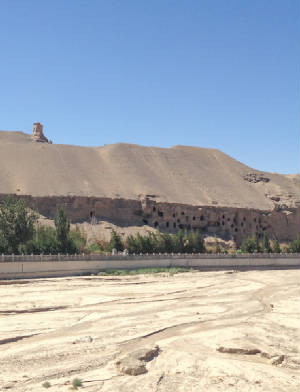
The longest of the physical ‘steps’ towards his enlightenment was a four-month expedition from Chongqing
to the ancient Mogao Grottoes, also known as the ‘Caves of the Thousand Buddhas’, near Dunhuang, Gansu province.
Surrounded by boundless desert, the small ‘oasis town’ of Dunhuang became an important
site for merchants traversing the ‘southern section’ of the Silk Road – the ancient superhighway between
China and the Western world. In the 1,000 years that followed the
excavation of the first grottoes in the 4th century AD by Buddhist monks, the Mogao Grottoes developed into one of the Buddhist
world’s greatest cultural sites. Mogao became a staging post for the spread of Buddhism from India to China; as well
as the place where Chinese monks could worship and meditate, before continuing their ‘Journey to the West’. For Joseph Needham, also, this was
as much a spiritual journey as it was an arduous physical one. His quest was to see with his own eyes the place where the
Diamond Sutra was ‘discovered’ a few decades before. This document, found in the ‘Library Cave’, is
regarded as one of the most important artefacts in the history of science. Remarkably,
it is precisely dated. The date that appears on the sutra corresponds to the 11th May 868 in the Gregorian calendar.
Even more remarkable is that it was not hand-drawn. It was printed…
…587 years before Johannes Gutenberg printed the Bible in Germany [1455]; and 608 years
before William Caxton published The Canterbury Tales, England’s first printed book [1476]. Recorded on the Diamond Sutra is the Chinese translation of a ‘question and answer’ dialogue between
a disciple, Subhüti, and the Buddha. An alternative name of this sutra, ‘The Perfection of Wisdom Text that
Cuts Like a Thunderbolt,’ seems entirely fitting as well as prophetic in that, more than any other, this was the
‘China first’ that had inspired Joseph Needham to embark on what would be a more than 50-year mission to persuade
the world that China had been the home of the world’s most advanced ancient civilisation by far.
His experiences and rich encounters during the numerous journeys that followed the ‘Dunhuang Expedition’
would convince him that the plan to write a “single slim volume” on the history of science in China needed to
be re-thought: “During my time in China I realised that one volume would not be enough, and that it would probably
have to be seven,” he wrote. Back in Cambridge, Joseph Needham began to type the pages that
would become the monumental Science and
Civilisation in China. He was surrounded
by mountains of beloved books from numerous Chinese sources. A kid in the world’s biggest and best sweet shop:
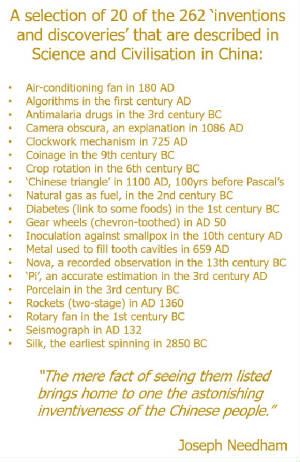
"What a cave of glittering treasures was opened up! …One after another, extraordinary
inventions and discoveries clearly appeared… often, indeed generally, long preceding the parallel, or adopted inventions
and discoveries of Europe. …Wherever one looked, there was ‘first’ after ‘first.’” Indeed, there were so many ‘firsts’ after ‘firsts’, that, although the
plan for seven volumes didn’t change, volumes 4 to 7 were split into 24 parts. Several of these were completed by academics
from the Needham Research Institute and published after his death in 1995. The final book in the collection,
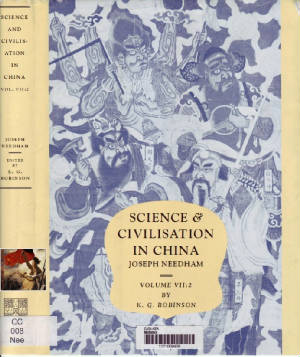
Science and Civilisation in China, Volume 7, Part II: General Conclusions and Reflections, lists the 262 ‘firsts’
that were described in earlier volumes of the work. But, why then
didn’t China go on to develop ‘modern science’ before the ‘industrial revolution’ in Europe,
instead of seemingly running out of creative steam at around 1500 AD? This is known
as the ‘Needham Question’. A Google search for the term and
‘1500 AD’ yielded 4,230 results, including links to numerous attempts to provide possible answers. Here’s one more: Could it be that,
after four millennia of frenzied activity, the Chinese Dragon had simply decided to take a well-deserved nap? It’s worth remembering that, for Chinese Dragons, 500 years is but a blink of an eye. Researched and written
in November 2019, and published in 'China Eye' magazine.

PLAY the PODCAST
References Agar, John (2012). ‘It’s Springtime for Science’: Reviewing China-UK Scientific Relations
in the 1970s. Notes and Records of The Royal Society, (2013) 67, 7–24. Blue,
Gregory (1997). Joseph Needham – A Publication History. Chinese Science 14 (1997): 90-132.
Davids,
Karel (2016). Religion and technological development in China and Europe between about 700 and 1800. Artefact Techniques,
histoire et sciences humaines. Dimaculangan, Pierre (2014). The Needham Question and the Great Divergence:
Why China Fell Behind the West and Lost the Race in Ushering the World into the Industrial Revolution and Modernity.
Comparative Civilizations Review: Vol. 71 : No. 71 , Article 10. Elman, Benjamin (2007). China and the World History
of Science, 1450-1770. Education About Asia, Volume 12, Number 1, Spring 2007. Finlay,
Robert (2000). China, the West, and World History in Joseph Needham's ‘Science and Civilisation in China’.
In the Journal of World History, Vol. 11, No. 2, pp. 265-303. University of Hawaii Press. Goldstone, Jack (2009). Why
Europe? The Rise of the West in World History, 1500-1850. McGraw-Hill. Goldsmith, Maurice (1995). Joseph
Needham: 2Oth-Century Renaissance Man. Unesco Publishing. Google (2019). Search results for the “Needham
Question” yielded 4,230 results (at 6pm Beijing time on the 27th October 2019). Gurdon J. and Rodbard, Barbara (2000).
Joseph Needham, C.H. 9 December 1900 — 24 March 1995. Biographical Memoirs of the Fellows of the Royal Society.
https://doi.org/10.1098/rsbm.1999.0091 accessed on the 19th October 2019.
Jun, Wenren (2013). Ancient Chinese Encyclopaedia of Technology: Translation and Annotation of the Kaogong
ji (The Artificers' Record). Routledge. Lee, Lily Xiao Hong, ed. (2003). Biographical Dictionary
of Chinese Women: The Twentieth Century 1912-2000, pp 382-384. An East Gate Book. Mei
J. (2019). Some Reflections on Joseph Needham's Intellectual Heritage. In Technology and Culture, Volume 60, Number
2, April 2019, pp. 594-603 (Article). Ministry of Culture and Tourism of the People's Republic of China.
Tourism data 2018 and 2017, via https://www.travelchinaguide.com/tourism/2018statistics/ accessed on the 23rd October 2019. Montgomery,
Laszlo (2015), Joseph Needham Part 1. The China History Podcast, number 155. https://www.teacup.media/2015/07/14/chp-155-joseph-needham-part-1/ Montgomery, Laszlo (2015), Joseph Needham
Part 2. The China History Podcast, Number 156. https://www.teacup.media/2015/07/14/chp-156-joseph-needham-part-2/ Mougey, Thomas (2017). Needham at the
crossroads: history, politics and international science in wartime China (1942–1946). In The British Journal for
the History of Science, Volume 50, Issue 1, pp 83–109. https://doi.org/10.1017/S0007087417000036 accessed on the 20th October 2019. Needham, Joseph (1943), representing the British Council Cultural Scientific Mission in China. Science
in Chungking. In Nature. July 17 1943, volume 152. Needham, Joseph (1943), representing
the British Scientific Mission in China. Science in Western Szechuan. In Nature. October 2 1943, volume 152, pp 372-374.
Needham, Joseph (1943). Journal written by Joseph Needham of his journey through northwest China to Dunhuang
between August-December 1943 (unpublished manuscript, 71pp. with four inserts). The Needham Research Institute, Cambridge:
NRI2/5/12/1. Needham, Joseph (1946), representing the British Scientific Mission in
China. Science and Technology in China’s Far South. In Nature. February 16 1946, volume 157, pp 177-179.
Needham, Joseph (1946). In the Catalogue of the papers and correspondence of Joseph
Needham CH FRS (1900-1995), biochemist and historian of science. Cambridge University Library: Department of Manuscripts
and University Archives. https://discovery.nationalarchives.gov.uk/details/r/87f77d01-d7c9-407d-a0fd-c139512e65a3 accessed on the 21st October 2019. Needham, Joseph (1949). Central Asia and the history of science and technology. In the Journal of
The Royal Central Asian Society, 36:2, 135-145. Needham, Joseph (1954) with the research assistance of Wang Ling. Science
and Civilisation in China, Volume 1: Introductory Orientations. Cambridge At The University Press.
Needham,
Joseph and Hartley Harold Brewer (1962). Sir Frederick Gowland Hopkins, O.M., F. R. S. (1861-1947) Centenary Lecture held
on 20 November 1961 in the University of Cambridge. In The Royal Society Journal of the History of Science, 31st December
1962, volume 17, issue 2, pp116-162. Needham, Joseph (2004) with the collaboration of and contributions by Kenneth
Girdwood Robinson and Ray Huang (Huang Jen-yu). Science and Civilisation in China, Volume 7, Part II: General Conclusions
and Reflections. Cambridge University Press. Raj, Kapil (2016). Rescuing
Science from Civilisation: On Joseph Needham’s “Asiatic Mode of (Knowledge) Production. In Arun Bala and
Prasenjit Duara, eds. The Bright Dark Ages: Comparative and Connective Perspectives. Brill, Leiden/Boston.
Sima, William (2015). Diplomat and Scholar: Frederic Eggleston in Chungking and Canberra, in 1941–1946.
In China and ANU [Australian National University]: Diplomats, Adventurers, Scholars. ANU Press, pp 35-62 [Chapter 2].
The British Library https://www.bl.uk/people/william-caxton [accessed on the 26th October 2019, “The
earliest book he printed in England”]; and https://www.bl.uk/collection-items/william-caxton-and-canterbury-tales [accessed on the 25th October 2018: “The Canterbury
Tales... first published in 1476”]. The Economist (2008). Question
marks. Why did China’s scientific innovation, once so advanced, suddenly collapse? A British academic made this question
his life’s work. Print edition, 5th June 2008. Wang Da-Jun (2005). Bell Chime, Dragon Washbasin:
Modern Scientific Information Hidden in Ancient Chinese Science and Technology. Technische Mechanik, 2005, 9-16.
Whitfield, Roderick et al (2015). Cave Temples of Mogao at Dunhuang: Art History on the Silk Road,
Second Edition. Getty Publications. Winchester, Simon. (2008). The Man Who Loved China: The Fantastic Story of
the Eccentric Scientist Who Unlocked the Mysteries of the Middle Kingdom. Harper. Zhang, Baichun and Tian Miao (2019).
Joseph Needham's Research on Chinese Machines in the Cross-Cultural History of Science and Technology. Technology
and Culture, Volume 60, Number 2, April 2019, pp. 616-624 (Article). Johns Hopkins University Press Zhang, Yaguang
et al (2015). Economic Cycles in Ancient China. Working Paper 21672. National Bureau of Economic Research, Cambridge,
Massachusetts, USA. Photos Photo of Joseph Needham in his study
at Cambridge University, 1965. By courtesy of Kognos. Creative Commons license; details: https://commons.wikimedia.org/wiki/File:Joseph_Needham_in_Cambridge_1965_04.jpg Photo of
a section of ‘The Caves of a Thousand Buddhas’, Mogao, Dunhuang, Gansu Province, taken by the author at 3.43pm
on the 24th July 2015.
|